
Bring MirraArena to Your Venue
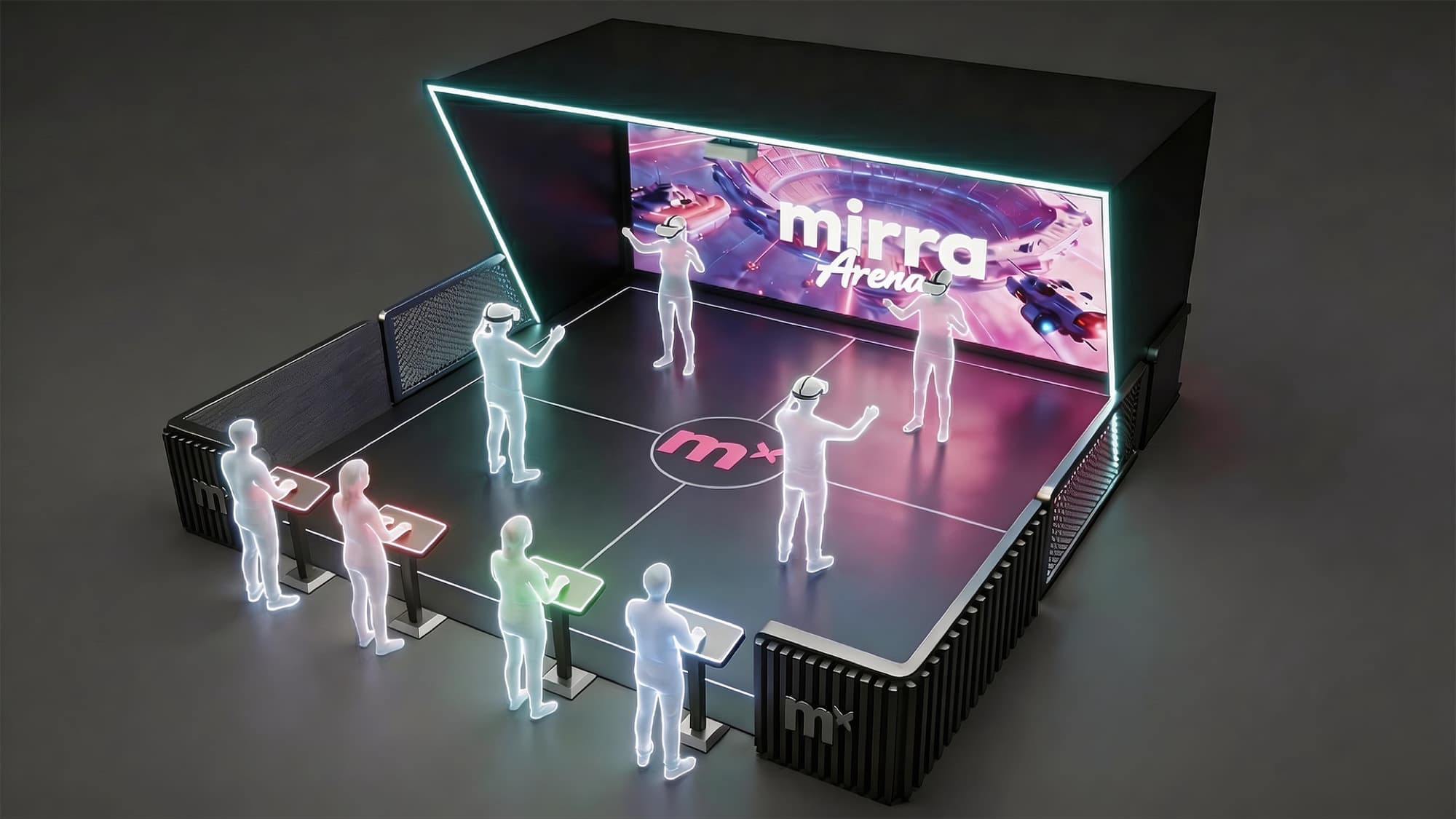
Turn Gameplay Into a Live Venue Experience
MirraArena is a Social Game Arena platform that turns hands-free group gameplay into live entertainment for the whole venue.
Players step into shared virtual worlds and compete using natural body movement. At the same time, their gameplay appears on a large shared display, where friends, families, and other guests can follow the action. Instead of separating players from everyone else, MirraArena gives the room one experience to watch, react to, and celebrate together.
For venue operators, that means adding more than a VR attraction. It means adding a visible, social experience that can support walk-in play, group celebrations, private events, and other programmed uses of the space.
What a MirraArena Partner Receives
MirraArena is licensed as a complete, integrated platform. The games, tracking, display experience, show production, and operating tools are designed to work together rather than as separate products.
A partner deployment can include:
- Hands-free VR hardware and full-body tracking
- A growing catalog of original party games
- The Mirra Show Engine, Mirra's automated show production system
- Live gameplay, scoring, team presentation, and between-round content for shared displays
- Arena and display design guidance
- Installation, launch, and staff training support
- Ongoing content, feature, and technical support under the applicable agreement
- Brand and marketing materials for local launch and promotion
The system is designed so one trained operator can run a game session without a separate host, DJ, or production crew.
A Format That Fits the Venue
MirraArena can be planned around different player capacities and display approaches.
The Grand format uses a 25-by-25-foot player zone and supports up to eight active players. The Compact format uses a 25-by-13-foot player zone and supports four active players. Display options are selected separately and can be designed around a dedicated LED wall or, where appropriate, an existing large-format venue display.
These dimensions describe the player zone only. Spectator space, display clearance, circulation, equipment, seating, and food-and-beverage areas are planned around the actual site. The right configuration depends on how the venue operates, not only on how much floor space is available.
What to Look for in a Demo
The best way to understand MirraArena is to see players and spectators experience the same round together.
A useful demo should make four things clear:
- Guests can join quickly. The games use body movement instead of handheld controllers and are designed to be understood without a long tutorial.
- Spectators can follow the action. The shared display makes the competition visible, including scores, key moments, and results.
- The room stays connected. Players, waiting teammates, friends, and event guests remain part of one social experience.
- The operating flow is practical. A trained team member can start sessions, guide guests, and keep play moving through a repeatable workflow.
The same platform can be evaluated for family entertainment centers, cinemas, bowling and hospitality venues, bars and nightlife concepts, resorts, malls, and standalone social entertainment destinations. The use case may be different—walk-in attraction, birthday destination, corporate event product, or multipurpose entertainment room—but the core player-and-spectator experience remains the same.
How the Partnership Starts
MirraArena requires a system investment and a licensing agreement. Commercial terms vary by market, arena configuration, display approach, and project scope. The partner kit provides the relevant hardware, installation, licensing, and support framework for a specific venue.
The first step is a venue-fit discussion. We review the location, available dimensions, ceiling height, infrastructure, operating model, target audience, and opening timeline. From there, the Mirra team can recommend an arena geometry and display approach, outline site requirements, and plan the path from design through training and launch.
To discuss your venue, send your city, venue type, available dimensions, and target opening date to partner@mirraarena.com.
MirraArena — Play. Watch. Celebrate.
Related reading: