
Bars + Social Arenas: How the Best Nightlife Venues Are Solving the Weeknight Problem
The Night That Wasn't Supposed to Be Memorable
Twenty people. Different cities. New Jersey, Houston, Philadelphia, a few more scattered across the country. They were in town for a conference, which meant they'd already sat through two days of panels, breakout sessions, and the kind of networking that feels like work because it is work.
The plan for the final evening was simple: grab drinks, wind down, call it a night.
Instead, they ended up at Mirra Arena. They started at the bar, a real bar, not a waiting room, then moved into a one-hour game show session. An hour later, nobody wanted to leave.
The organizer, someone who runs corporate events for a living, someone who has seen every variation of "fun team activity" that exists, said she'd never seen anything like it. Not the games themselves. Something else: for the first time all week, everyone was actually together. Not physically together. Together together. Locked in, yelling at each other, laughing, watching. The people playing were completely focused. The people watching were completely invested. Nobody was on their phone.
That's the thing Mirra does that almost nothing else does. And it's the thing that every bar operator in the country should be paying attention to.
What Bars Are Actually Selling
Here's the honest version of the bar business: you're not selling drinks. You're selling a reason for people to be somewhere together.
Drinks are the medium. The real product is the night, the story people tell the next day, the group photo that gets sent around, the moment that turns a Tuesday into something worth remembering.
The problem is that most bars have stopped thinking about how to manufacture those moments. The formula hasn't changed in decades: good music, good drinks, maybe a game on the TV. And for a while, that was enough.
It isn't anymore.
The venues that are full on weeknights, actually full, not just the bar stools, have figured out that they need to give people a reason to show up beyond the drinks themselves. Trivia nights. Comedy. Live music. Axe throwing. Bowling. The activity is the anchor; the bar is what wraps around it.
The question is: which activity actually works?
Why Most Bar Activities Don't Stick
Axe throwing is a good example. It surged, it peaked, and most of the venues are now competing on price. The problem: once you've thrown axes a few times, there's no reason to go back. The activity is the same on visit 50 as it was on visit 1. There's no escalation, no narrative, no moment that feels like a live event.
Bowling has the same problem. Darts. Shuffleboard. Even escape rooms, great for a first-timer, but the repeat visit rate is terrible because the experience is identical every time.
The formula these venues are all missing: people don't return to activities. They return to experiences that make them feel something they can't feel at home.
And specifically, they return to experiences that are social in a way that's hard to engineer elsewhere: where the group is genuinely locked in together, where the energy in the room is reactive and unpredictable, where something happens that nobody planned.
The Screen Changes Everything
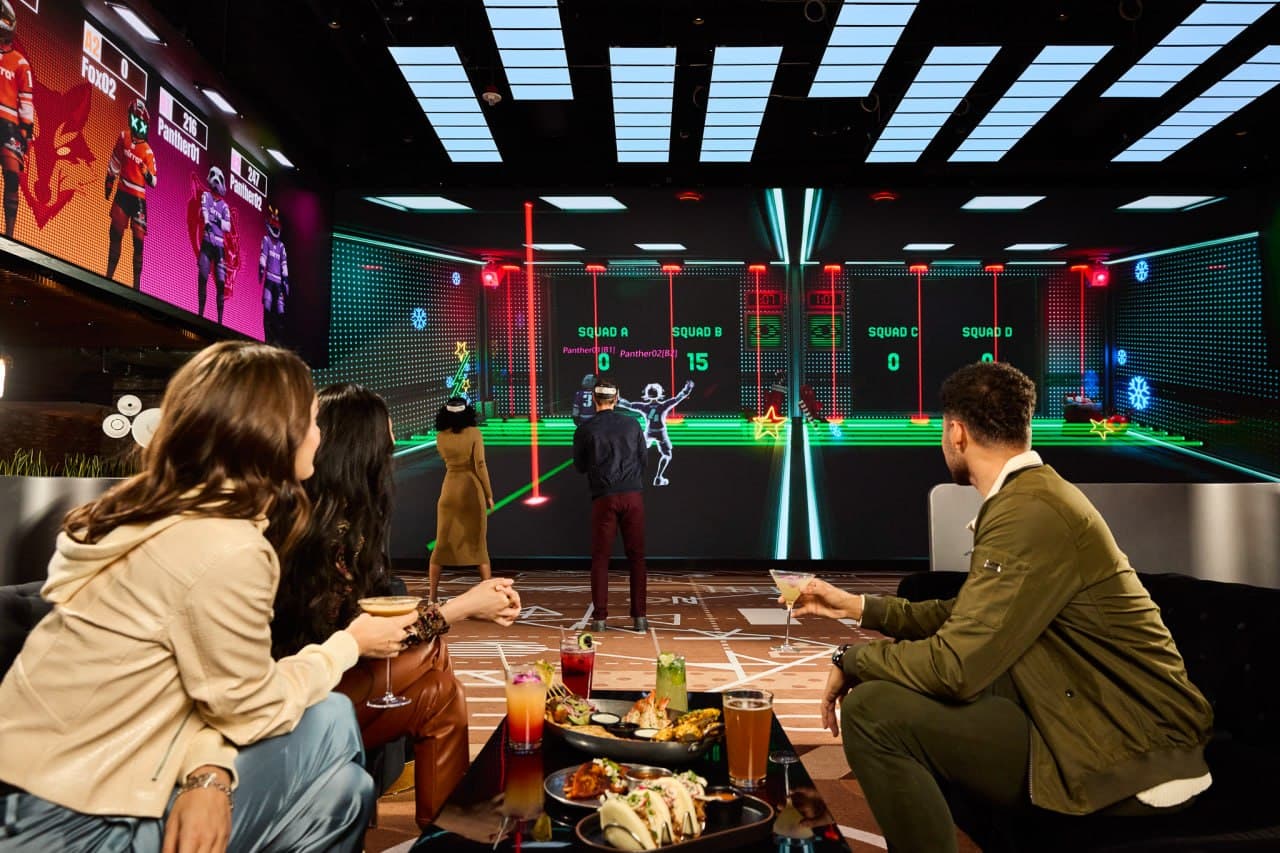
Mirra Arena looks like a bar with an arena attached. That's intentional. The bar isn't decorative, it's structural. Guests arrive, they have drinks, they watch. Then they play. Then they're back at the bar talking about what just happened.
But the thing that makes the format work isn't the bar, and it isn't even the games. It's the 25-foot LED wall.
Here's why: every other VR product puts the experience inside the headset. The people playing disappear into their own world. Spectators see someone waving their arms at nothing. There's nothing to watch, nothing to react to, no shared moment.
Mirra flips this completely. The LED wall broadcasts every player's perspective as a live show, cinematic angles, real-time scoring, the full chaos of what's happening inside the game. Every person in the room is watching the same screen. The players can hear the crowd. The crowd is reacting to what the players are doing. It's not VR anymore. It's a live event.
That's what happened with the conference group. The people on the sidelines weren't bored. They were in it: shouting, reacting, watching their colleagues do things they'd never seen them do. The screen is what connected the room. And once a room is connected like that, something shifts.
What "In the Moment" Actually Means for a Venue
The phrase gets used a lot in hospitality: "we want guests to be present, to disconnect, to really be here." It's aspirational language that rarely describes what actually happens.
What actually happens: people check their phones. They have side conversations. They half-watch whatever's on. The group splinters into smaller groups, and then smaller ones, and by the end of the night, the cohesion that made the evening feel special has quietly dissolved.
Mirra Arena doesn't let that happen. Not because of some clever UX trick, but because the format is structurally incompatible with passive participation. When the game is live on the screen, everyone's attention is pulled to the same place at the same time. When a player does something unexpected, falls, recovers, takes the lead in the final seconds, the room reacts as a room. That's not something you can manufacture with a trivia app or a projector screen playing sports highlights.
The group from the conference wasn't having fun despite being strangers from different cities. They were having fun because the format gave them something to share. The game became a common reference point for twenty people who had almost nothing else in common. By the end of the session, they had inside jokes. They had moments. They had a reason to talk to each other that wasn't professional obligation.
That's what bars are actually trying to sell. Most of them just don't have a format that delivers it reliably.
The Operator Math
From a venue economics standpoint, the bar and arena format has one property that almost everything else in the entertainment industry doesn't: it increases bar revenue rather than competing with it.
A typical bar without an activity anchor: guests arrive, have one or two drinks over 45 minutes, and either leave or migrate somewhere else.
A bar with a Mirra Arena session: guests arrive early to watch, have drinks while waiting for their slot. They play for an hour. They come back to the bar afterward to process what happened. The conversation is electric, because they all just shared something. Total dwell time: 2.5 to 3 hours. Drink spend: substantially higher, not because you upsold them, but because they want to stay.
The math isn't complicated. Longer dwell time means more bar revenue. More bar revenue means the arena pays for itself faster. And the arena is the reason people come back on a weeknight when they have no other reason to leave the house.
What Comes Next
The venues that figure this out first will own the weeknight. The format is still new enough that being early is a real advantage. The bar that adds a Mirra Arena in a market that doesn't have one yet gets to be the place everyone talks about, the option that shows up when a group is trying to figure out where to go.
The conference organizer who said her group didn't want to leave? She's already thinking about the next event. That's the part that doesn't show up in the one-night revenue number but drives every decision that comes after it.
The people who came from New Jersey and Houston and Philadelphia went home with a story. Stories are how nightlife venues grow.
Mirra Arena is available for licensing at bars, hospitality venues, and nightlife operators. Contact us to learn more about bringing a Mirra Arena to your venue.
Related reading: