
What Is a Social Game Arena? The New Category Reshaping Group Entertainment
A New Category Needs a Name
When something genuinely new enters the market, the hardest part is often just naming it clearly enough that people know what it is.
A Social Game Arena is not a VR arcade. It's not an escape room. It's not a bar with games on the side. It's not a bowling alley, a laser tag facility, or a competitive socializing venue. It has elements in common with all of these, but it works differently at a fundamental level, and the difference matters.
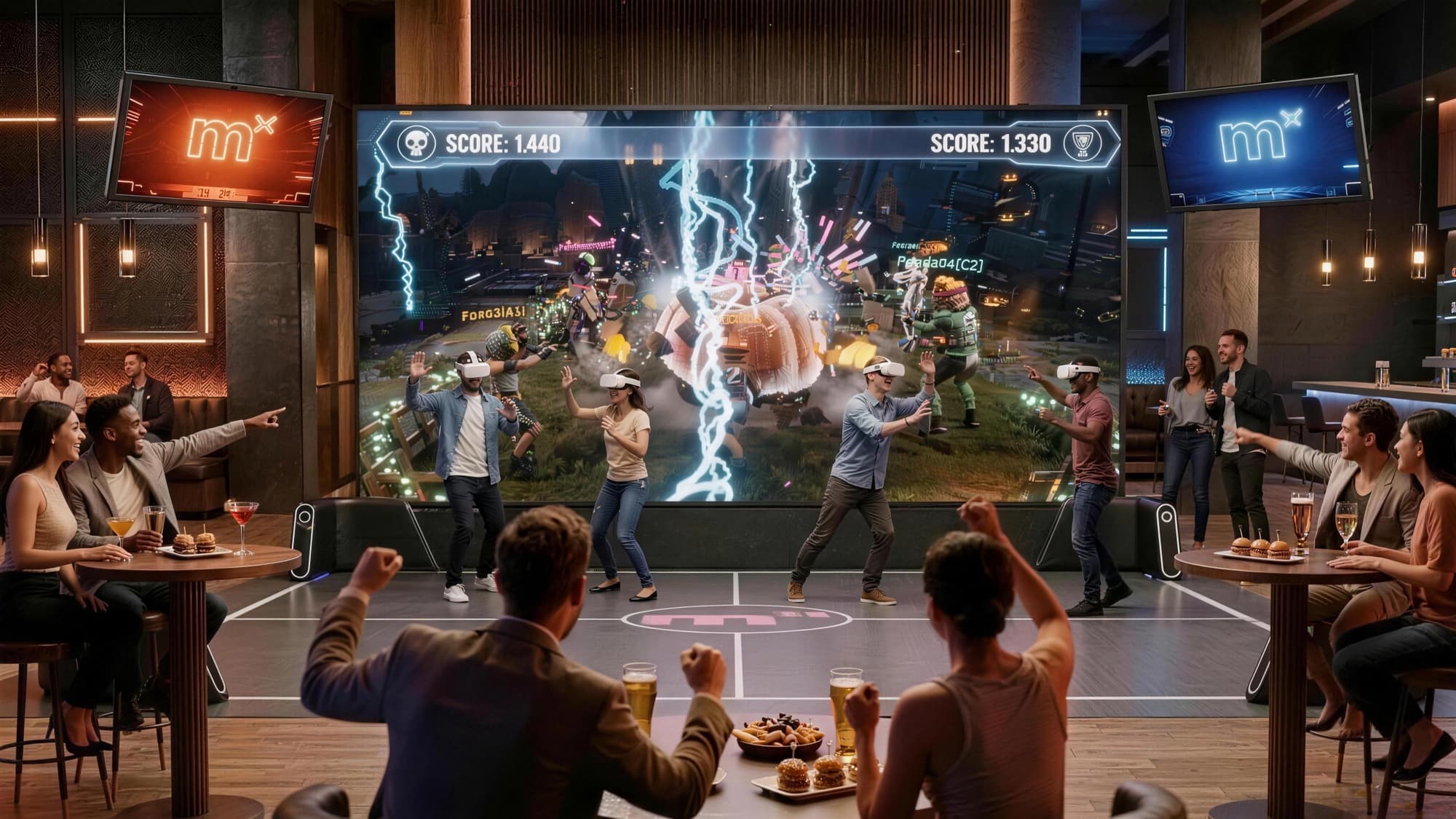
Here's the clearest definition: A Social Game Arena is a physical venue where groups compete inside immersive VR game worlds while a live audience watches the action in real time on large shared displays, creating a simultaneous experience for both players and spectators.
The key word is simultaneous. Not players first, then spectators clap at the end. Not spectators waiting for players to finish. Players and spectators share the same experience at the same time, just from different vantage points.
The Three Defining Elements
Every Social Game Arena has three components that work together as a system. Remove any one of them, and you have a different product.
1. Immersive Player Experience
Players enter a physical arena space and put on VR headsets, typically lightweight, hands-free systems that use full-body tracking instead of hand controllers. They are transported into a game world where their entire body is the interface. They run, reach, throw, dodge, and cooperate.
The games are designed for groups: competitive formats, team dynamics, and moment-to-moment action that makes sense to an outside observer. This last point is critical. Many VR experiences are designed purely for the person inside the headset. Social Game Arena games are designed to be watchable, which changes how they are built.
2. Live Spectator Broadcast
Everything happening inside the VR game is broadcast in real time to large LED display walls visible throughout the venue. The spectator experience is not an afterthought, it is engineered from the ground up.
AI-powered show systems automatically select camera angles, generate instant replays, highlight critical moments, and run a virtual host that keeps energy high between rounds. No human production crew is required. The result is a live broadcast that feels like watching a sporting event or game show, except the athletes are your friends and the game was designed to be chaotic and funny.
This is what makes spectators genuine participants rather than waiters. They react, cheer, film, share. They are part of the experience even without headsets on.
3. Shared Physical Space
The arena, the spectator area, and (in most implementations) a food and beverage component are in the same room or connected space. The group is never fragmented. The person not playing is not in a lobby looking at their phone, they're watching from the bar, or the lounge, or the spectator gallery, and they're engaged.
This shared space is what drives the business economics of Social Game Arenas. Engaged spectators stay longer. They order food and drinks because they're genuinely having a good time. And they produce organic social media content, filming the screen, filming their friends' reactions, that serves as earned marketing.
Why This Category Is Emerging Now
The Social Game Arena format became commercially viable in the early 2020s due to the convergence of several technologies:
Real-time VR rendering at broadcast quality. Until recently, VR gameplay could not be cleanly broadcast to external displays without significant lag or image degradation. The hardware and rendering pipelines now exist to show what's inside the headset on a 25-foot screen in real time, cleanly.
Full-body tracking without cumbersome hardware. Early VR systems required backpacks, multiple handheld controllers, and lengthy calibration. Modern inside-out tracking and body-tracking systems allow players to enter an arena, put on a lightweight headset, and be playing within seconds. This dramatically lowers the barrier to entry, and makes the gameplay visible in a way that hand-controller-based VR never was.
AI-powered show production. Producing a live show that looks professional, camera direction, replays, commentary, transitions, traditionally required skilled crew. AI production systems now automate these tasks at a quality level that would have required multiple specialists five years ago. This makes it economically viable to run show-quality entertainment every session, every day, with standard venue staffing.
Software-delivered content. Because the experience runs on a software platform, venues can receive new games, seasonal themes, and branded content as updates, exactly like a streaming service adds new titles. This is critical for repeat visits, which are the lifeblood of any venue business.
How It Differs From Other Formats
| Format | Player Experience | Spectator Experience | Group Cohesion | |---|---|---|---| | VR Arcade | High, solo immersion | None, spectators see nothing | Low, group fragments | | Escape Room | Medium, puzzle-solving | None, spectators wait outside | Medium, team collaborates, no audience | | Free-Roam VR | Very high, full movement | Minimal, small screens nearby | Low, group fragments | | Bowling / Mini Golf | Low-medium, turn-based | Passive, watch people take turns | Medium, group together, but idle | | Live Axe Throwing / Topgolf | Medium, skill-based activity | Passive, watching is incidental | Medium, F&B focused, activity secondary | | Social Game Arena | High, full-body immersion | High, live broadcast on massive screen | High, players and spectators share same moment |
The Social Game Arena format is the only one in this table where the spectator experience is designed to be as engaging as the player experience.
The Business Model Advantages
For venue operators, the Social Game Arena format creates economics that differ meaningfully from traditional entertainment venues.
Revenue per square foot is unusually high. An arena that serves 8 active players but genuinely entertains 50–300 spectators generates revenue from the entire room, not just the people playing. When spectators are engaged, they spend on food and beverage, which typically carries 60–75% margins compared to single-digit margins on activity fees alone.
Software drives retention without capital expenditure. Traditional attractions, escape rooms, bowling, laser tag, require physical renovation to meaningfully refresh the experience. Social Game Arena venues run on software platforms. New games arrive as updates. A venue that opened in 2024 has different content in 2026, without a construction crew.
Every session generates organic marketing. When gameplay is visible on a shared screen and spectators are filming reactions, user-generated social media content is produced every day without a dedicated marketing team. The Sweet Kitchen game at Mirra Arena's Bellevue flagship has generated over 800,000 views across social platforms, almost entirely from guests filming their own sessions.
Labor requirements are lower than they appear. AI show engines handle production tasks that would require a host, DJ, and tech operator in a traditional entertainment format. One staff member can run a full session. In an industry where labor is consistently the largest operational challenge, this is a significant structural advantage.
The Competitive Context
The Social Game Arena category sits at the intersection of several converging trends in entertainment:
- Consumers increasingly choosing experiences over products
- Group bookings (corporate, celebrations, social outings) growing as a share of entertainment spending
- Content platforms and IP holders seeking new interactive formats for branded experiences
- Venue operators looking for formats that drive F&B and repeat visits, not just activity fees
Traditional entertainment formats, bowling, laser tag, free-roam VR, escape rooms, are valuable, but each has structural limitations that the Social Game Arena format addresses. The result is a new format that can co-exist with or partially replace these in the right venue context.
Current Operators
MirraArena, developed by Mirra Immersive, is the first commercial operator of the Social Game Arena format, with locations in Bellevue WA, Shanghai, Chongqing, and Beijing. The platform is available for licensing by entertainment venues globally, including movie theaters, family entertainment centers, malls, hotels, and standalone entertainment destinations.
More information: mirraarena.com
Related reading: